Embodiment and Enactivism
In psychology and cognitive science, the concept of embodiment is often associated with embodied cognition, which refers to the idea that studying mental life can’t be divorced from the body. But in the enactivist sense developed here, embodiment means more than simply having a physical body. The question is how bodily organization participates in the ongoing activity and way of life of a living system.
The focus here is enactivism, an approach to understanding cognition and living organization whose biological roots lie in work by the Chilean biologists Humberto Maturana and Francisco Varela beginning in the 1970s. Their ideas about autopoiesis, autonomy, and the relation between organism and environment later became central to one important strand of enactivist thought (Varela et al., 1991). This perspective challenges traditional views of the organism-environment relationship, proposing that living things are autonomous entities that define themselves from within, rather than being determined solely by external factors.
Enactivism includes several approaches. Some focus on how perception depends on movement and sensory activity. Others question whether cognition requires internal representations of the world. Enacting Life follows the biological or autopoietic approach, which begins with how living things produce and maintain themselves. From this perspective, understanding cognition requires explaining how things become significant for a living being. Ward (2026) draws a useful distinction here: some approaches explain meaning through the processing of information, while others ground it in the organization and activity distinctive of living things.
Autopoiesis and Living Autonomy
Maturana and Varela (1980) coined the term autopoiesis as a combination of the Greek auto (self) and poiesis (production or creation). Their work on autopoiesis became a foundation for this biological strand of enactivism, which emphasizes that living beings actively self-create and self-maintain their organization. An autopoietic system is a network of processes and relations that actively produces and regenerates itself, in the face of tendencies that would otherwise dissolve the system.
In their initial theorizing, Maturana and Varela focused on the individual cell as an autopoietic system. The cell membrane is not simply a container around the processes of life. The network of processes within the cell produces and replaces components that allow that network to continue, including the components through which its boundary is maintained. What matters is this circular organization of production, not simply a contrast between order inside the cell and disorder outside it.
A key characteristic of an autopoietic entity is that it creates and maintains itself without external “instructions”. This connects to what is often called organizational or operational closure in enactivist work. Maturana and Varela more often wrote about organizational closure. For our purposes, this means that the system’s own organization determines its operation rather than external instructions specifying what it should do. Cells remain open to exchanges of matter and energy, but those exchanges do not determine the organization from outside.
Although these ideas were initially applied at the level of the individual cell, they can also be considered at the level of a multicellular organism. This has implications for understanding the autonomy of living things: if we see an organism as being self-creating and self-maintaining, it follows that it is not determined in any simple way by its environment. Enactivism proposes that because of this lack of external determination, living things have a particular kind of autonomy.
Enactivists use autonomy in a more specific sense than the everyday idea of acting without outside control. The term has a longer philosophical history, including debates about self-organization and natural purposiveness, but the biological claim here can stand on its own. A living system participates in producing and maintaining the organization through which it continues to exist. Its autonomy therefore means that environmental events do not specify the system’s organization from outside, not that everything comes from inside or that the environment is causally unimportant.
This does not make an organism a sealed unit. Humans depend on the bacteria living in their guts for digestion, immune function, and aspects of development, and some philosophers of biology argue that this makes the boundary of the self-producing system harder to draw than early work on autopoiesis assumed (Reynolds & Baedke, 2026). Machines can also be autonomous in a functional sense, and some may operate for long periods without continuous external control. The stronger question is whether a system’s own activity participates in producing and maintaining the organization from which its norms arise. A hammer can fail too, but only by our standards: it breaks while we are using it. Present artificial systems do not appear to be organized in this way. Whether a nonliving system could ever achieve something comparable remains a separate theoretical question.
In the companion resource About Development, “organization” names changing relations among cells, bodies, and activities as form and capacities develop. Maturana and Varela use the word more specifically in asking how a living system remains a living unity through such changes. For them, autopoiesis names the circular relations through which a system produces and maintains itself. Structure refers to the particular components and relations through which that organization is realized at a given time. A frog can change its body and capacities while remaining alive. Autopoiesis alone does not explain why it develops as a frog.
Systems with very different structures could in principle share the same kind of organization. All living systems we know are cellular, but autopoiesis does not specify a particular list of molecules or a particular cellular architecture. The organization/structure distinction therefore leaves open the theoretical possibility that a very different material structure could realize a comparable self-producing organization.
A change in the environment can perturb an organism: it can trigger a change without instructing the system what change to make. What an organism can perceive and do depends on its present structure. For instance, whether changes in illumination can affect an organism depends on whether it has structures that are sensitive to light. Similarly, that a bacterium is affected by sugar depends on the structure of the bacterium, not simply on the nature of the sugar itself.
Structural Coupling
Although the idea of operational closure might suggest that a living cell (or a living organism) is an isolated unit, cut off from its environment, Maturana and Varela noted that a cell is not completely closed off: it exchanges matter and energy with its environment in order to maintain the organization within itself. Enactivism frames this relation between the individual cell (or organism) and its environment in terms of structural coupling.
How do we capture the individuality of a living thing as a self-determined entity, while still allowing for a connection with the outside world? This question reflects a primordial tension at the heart of autopoiesis: The need to preserve yourself as a distinct entity, which could mean closing yourself off from the environment. But at the same time, in order to maintain itself, the individual must tap into flows of matter and energy from the world that it inhabits. So although being a distinct entity might suggest a separation from the environment, being self-producing and self-maintaining requires the individual to be coupled with its environment, while not becoming dissolved in it.
Structural coupling joins organism and environment without erasing the distinction between them. The organism has a boundary and is individuated in a way that the surrounding medium is not.
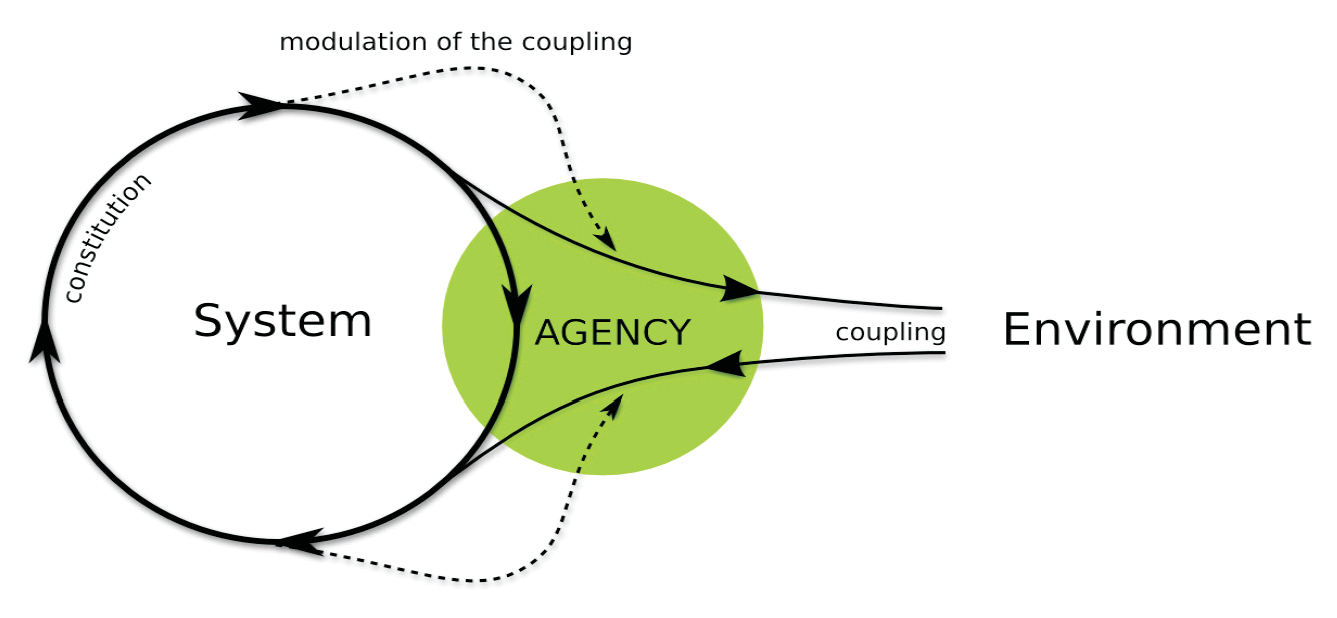
The organism also acts on the environment differently from the way the environment acts on it: what happens in an interaction can sustain or undermine the organism’s continued organization, and the medium has no such stake. Later enactive work develops this asymmetry into an account of normativity and agency.
Agency involves more than being a source of activity. These accounts also emphasize regulation in relation to norms: the organism changes its activity in ways that bear on conditions for its continued way of life. These norms do not have to be represented as explicit goals, and self-maintenance should not be treated as though the organism were following an internal instruction to survive.
Barandiaran et al. (2009) formulate agency in terms of three closely related conditions: individuality, interactional asymmetry, and normativity. An agent is a distinguishable system, it is an active source of interaction rather than merely being carried along by external events, and its activity is regulated in relation to norms. The figure below from Barandiaran et al. (2009) illustrates this account of agency.
A World of Meaning
Acting according to goals or norms raises a question about meaning: what does it mean to say that something is meaningful for an organism? A bacterium moving toward sugar can be described mechanistically in terms of chemotaxis, and evolutionarily in terms of why sensitivity to nutrient-relevant conditions was retained. Those explanations are important, but neither by itself settles what it means to say that sugar has significance for the bacterium rather than simply causing a response. Later enactive work offers one answer by relating significance to the organization, viability, and regulated activity of the living system.
This is the idea of sense-making: the claim that an organism’s surroundings can take on significance in relation to its own way of life. The idea is meant to apply well beyond animals with nervous systems. A bacterium is therefore a useful test case, precisely because nothing in the argument requires conscious reflection. Thompson and Stapleton (2009) make the point with the following example:
Consider motile bacteria swimming uphill in a food gradient of sugar. The cells tumble about until they hit upon an orientation that increases their exposure to sugar, at which point they swim forward, up-gradient, toward the zone of greatest sugar concentration. Sugar is significant to these organisms and more of it is better than less because of the way their metabolism chemically realizes their autonomous organization. The significance and valence of sugar are not intrinsic to the sugar molecules; they are relational features, tied to the bacteria as autonomous unities. Sugar has significance as food, but only in the milieu that the organism itself enacts through its autonomous dynamics. This example is meant to illustrate that even the simplest organisms regulate their interactions with the world in such a way that they transform the world into a place of salience, meaning, and value—into an environment (Umwelt) in the proper biological sense of the term. This transformation of the world into an environment happens through the organism’s sense-making activity. (Thompson & Stapleton, 2009, pp. 24–25)
The biological behavior in this example does not by itself demonstrate that sugar has meaning for the bacterium; that is the enactivist interpretation being proposed. On this view, aspects of the world can have salience, meaning, and value in relation to the organization and activity of the individual organism. Sugar is not meaningful because of a property carried by the sugar molecule alone. Its significance as food depends on the relation between the molecule and a living system for which that relation bears on the continuation of its way of life.
This is the stronger sense in which embodied activity can be said to enact an environment rather than merely register features of a pre-given world. The example also has limits. It shows a single cell with no developmental history and no relations with other organisms. De Jaegher and Di Paolo (2007) extend sense-making to interaction between agents, in which meaning is generated in the interaction itself rather than by either participant alone. They call this participatory sense-making.
Di Paolo (2005) argues that autopoiesis alone gives us an important but limited contrast between continued self-production and disintegration. A richer account of sense-making requires adaptivity: the capacity of an organism to regulate its activity in relation to conditions that bear on its viability. On this view, something can be better or worse for the organism. Normativity is grounded in a way of life that can be sustained, strained, or lost.
References
Maturana, H. R., & Varela, F. J. (1980). Autopoiesis and cognition: The realization of the living. D. Reidel. https://doi.org/10.1007/978-94-009-8947-4
Varela, F. J., Thompson, E., & Rosch, E. (1991). The embodied mind: Cognitive science and human experience. MIT Press.
Di Paolo, E. A. (2005). Autopoiesis, adaptivity, teleology, agency. Phenomenology and the Cognitive Sciences, 4(4), 429–452. https://doi.org/10.1007/s11097-005-9002-y
Thompson, E., & Stapleton, M. (2009). Making sense of sense-making: Reflections on enactive and extended mind theories. Topoi, 28(1), 23–30. https://doi.org/10.1007/s11245-008-9043-2
Barandiaran, X. E., Di Paolo, E. A., & Rohde, M. (2009). Defining agency: Individuality, normativity, asymmetry, and spatio-temporality in action. Adaptive Behavior, 17(5), 367–386. https://doi.org/10.1177/1059712309343819
De Jaegher, H., & Di Paolo, E. (2007). Participatory sense-making: An enactive approach to social cognition. Phenomenology and the Cognitive Sciences, 6(4), 485–507. https://doi.org/10.1007/s11097-007-9076-9
Reynolds, J., & Baedke, J. (2026). From autopoiesis to symbiotic entanglement: Rethinking enactivism through metabolism and microbes. Adaptive Behavior, 34(4–5), 295–306. https://doi.org/10.1177/10597123251405680
Ward, D. (2026). What is enactivism? Adaptive Behavior, 34(4–5), 253–271. https://doi.org/10.1177/10597123261450094